This article is re-posted from the Spark Climate Insights Substack channel. Subscribe to catch all the insights.
With 2026 forecast to be one of the warmest years on record, and current El Niño conditions projected to make 2027 even warmer, the sixth State of the Climate Report, published by Prof. Bill Ripple and colleagues last week, provides a timely reality check. Unfortunately, it shows that virtually all of the 16 critical climate indicators are headed in the wrong direction and seven of those—including atmospheric carbon dioxide, methane, and nitrous oxide concentrations—are now at record observed highs. These trends are taking the Earth system ‘deeper into uncharted territory’.
The reasons why are well-known: continued burning of fossil fuels, global agriculture, and deforestation are exhausting the remaining carbon budget to limit warming below 1.5°C, setting humanity on the trajectory of a climate overshoot, as confirmed recently by UNEP’s Limiting Overshoot Report. While direct human emissions are undeniably the root cause of these escalating climate risks, they no longer tell the full story. Emerging climate feedbacks—changes that we are triggering in nature—are starting to show signs of acting as an accelerant, amplifying human emissions and compounding risks.
This year’s State of the Climate Report shows that some key climate indicators, like ocean heat content, are not only high, but appear to be increasing at accelerating rates or showing signs of abrupt shifts. That’s cause for concern. If climate risks are indeed speeding up, and may accelerate more as we approach certain tipping thresholds, it’s imperative that we improve our understanding of what exactly is driving these accelerating risks and what can be done to slow them down. That’s the focus of much of our work at Spark. My colleagues are working on science and solutions for several big, under-addressed sources of risk, like Earth’s declining reflectivity and increasing energy imbalance, and ongoing growth in methane emissions and atmospheric concentrations, and nitrous oxide. The program I lead focuses on another major risk multiplier: warming-induced emissions, which, as this year’s State of the Climate Report points out, could amplify warming by ~20-30% this century (these numbers include important caveats, discussed more below).
In this post, I’ll provide an overview of warming-induced emissions and their significance, dig into why they have remained a blind spot, and discuss the bigger question of what we can do to reduce this important source of climate risk.
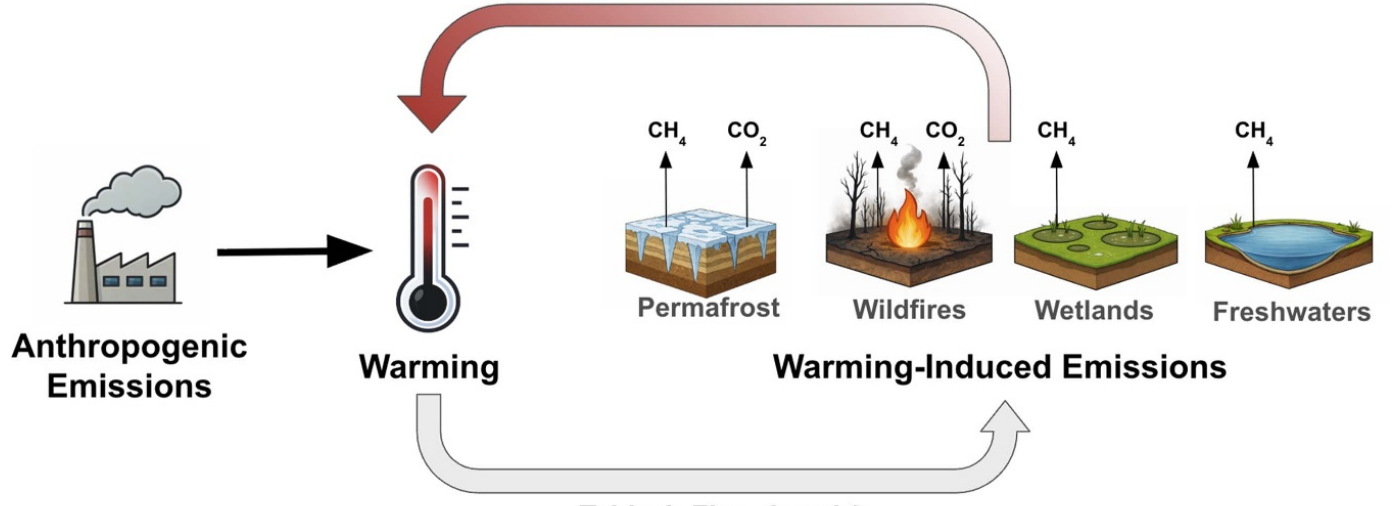
First, a quick recap of warming-induced emissions. As the planet warms, changes in natural systems and processes—such as thawing permafrost, warming wetlands and inland waters, and the expansion and increasing severity of wildfires—release additional carbon dioxide, methane, and nitrous oxide, which add to direct emissions from human activity and cause further warming in a self-reinforcing feedback loop (see Figure 1 below). Researchers have anticipated these feedbacks for a long time, but there are still major gaps in both our understanding and in strategies to respond to these risks.
The estimates cited in the State of the Climate report are based on recently published research led by our team at Spark (Sam Abernethy, Danie Potocek, Ilissa Ocko, Phil Duffy, and myself) in collaboration with our partners at the Environmental Defense Fund, Woodwell Climate Research Center, and Stanford University. Our paper shows that warming-induced emissions could amplify warming by about 0.2 to 0.4°C by 2100 depending on the human emissions scenario we follow, which represents a ~20-30% amplification of post-2020 warming by 2100. It’s important to emphasize that these initial estimates include significant uncertainties, and a larger effort is currently underway to provide much more robust estimates (more on that in the next section). It’s also important to emphasize that warming-induced emissions respond directly to human emissions: the less we emit from fossil fuels, agriculture, and other sources, the less nature emits. We developed this interactive explainer to let you toggle between different scenarios to see how warming-induced emissions respond to different anthropogenic emissions scenarios.
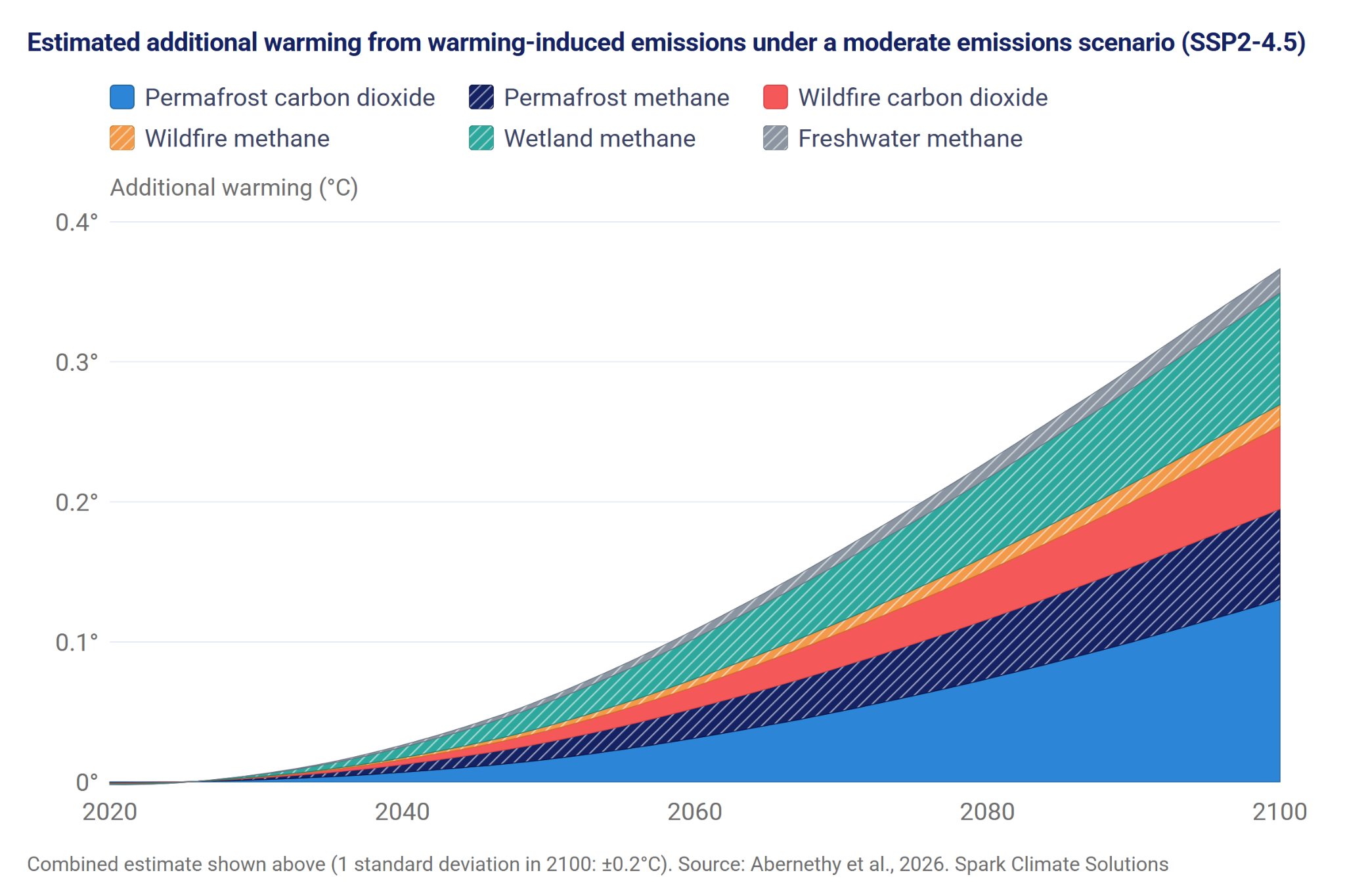
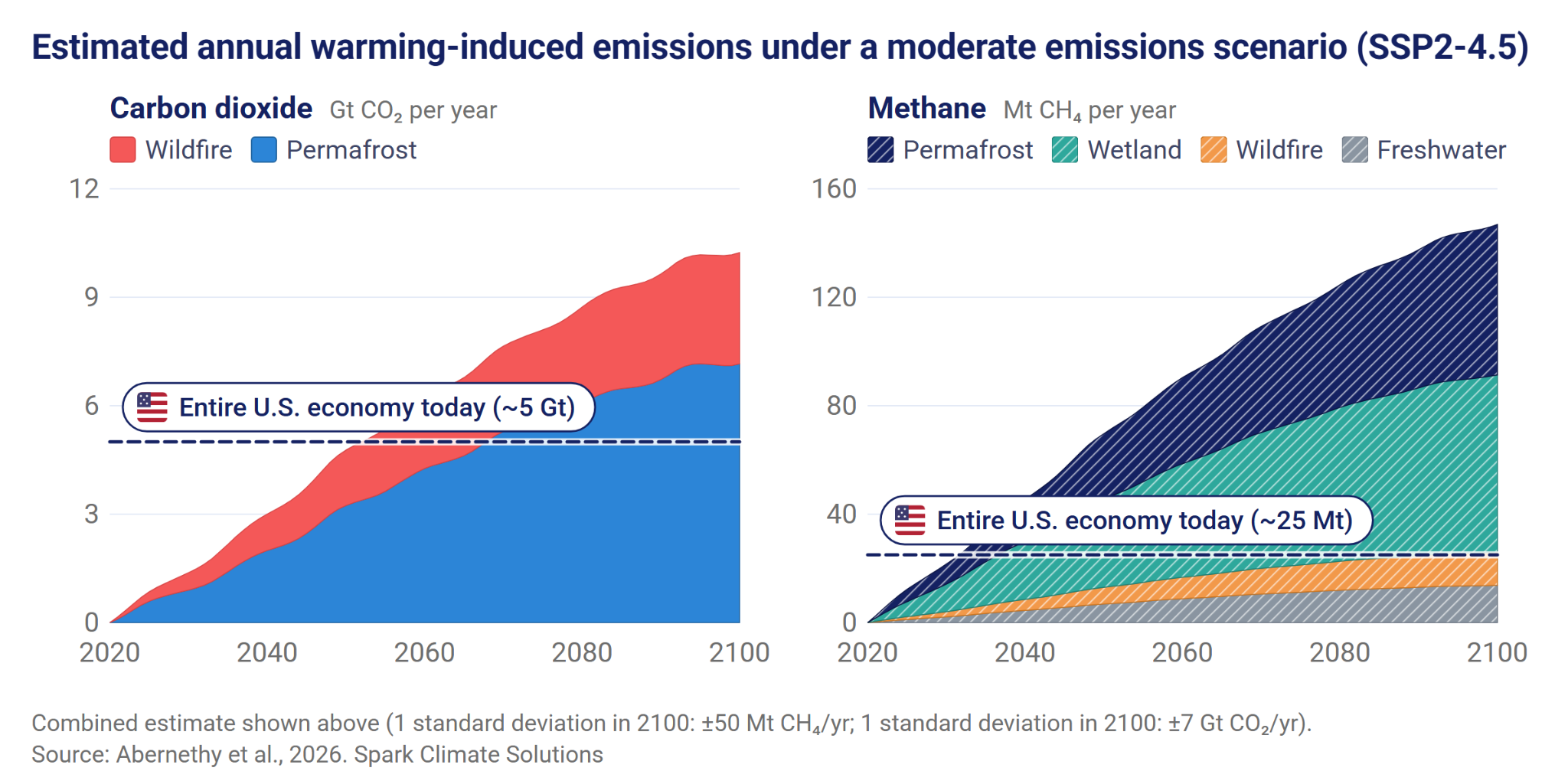
The graphic above shows one example of projected temperature impacts, under a mid-range future emissions scenario (SSP2-4.5). From an emissions perspective, the scale of these feedbacks is also quite significant. For example, in this same scenario, warming-induced emissions are expected to release about 2x as much carbon dioxide and about 6x as much methane as the entire current U.S. economy across all sectors (see graphic below).
Despite this significance, warming-induced emissions remain a major blind spot in climate models and policies. Of the 11 Earth system models used in the most recent IPCC assessment report, none included all four of the largest expected warming-induced emissions sources: none included wetlands and freshwaters, only two included permafrost, and five included wildfire (which are reaching record extremes per the State of the Climate Report). This gap is now partially being closed, for example, there are now several Earth system models that do include methane from wetlands, but we are still far from having all key warming-induced emissions processes represented across IPCC models.
Graphic: Inclusion of warming-induced emissions in the 11 Earth system models used in the most recent IPCC assessment (AR6)

The positive news is that warming-induced emissions are starting to get more serious attention, including in influential documents like the State of the Climate Report. And as awareness and understanding of these risks grow, we can begin to mount appropriate responses. So what does a pathway to reduce risks from warming-induced emissions look like? Here are four main strategies, and how we’re supporting work across each:
1) First, better monitoring and modeling of these emissions is critical to understand the full scale of the challenge and inform appropriate responses.
You can’t manage what you don’t measure. Satellite and ground-based monitoring systems can serve as early-warning systems to detect major changes and play a critical role in providing much-needed information to improve scientific understanding and the accuracy of estimates of these feedbacks. Unfortunately, there are important gaps and challenges in tracking warming-induced emissions with today’s monitoring infrastructure. These blind spots make it harder to manage risks. For example, currently, a natural methane surge could run for years before it’s discovered. Last year, we brought researchers together at the Aspen Global Change Institute to develop a plan for a ground-based Global Ecosystem Methane–Observation System (GEM-OS), which would address gaps in our ability to monitor natural methane emissions in particular. I also recently wrote a more detailed piece on the broader space-based observation needs in the Earth Observation in the Era of Climate Overshoot for the International Space Science Institute. Priorities include sustaining our current observing ‘fleet’ of satellites, improving the sensitivity of instruments, and filling gaps in current ground-based infrastructure.
A second challenge is modeling. Given that warming-induced emissions are poorly captured in current models, those models (and the policies and strategies based on them) are likely underestimating the risks ahead. This isn’t because of negligence or lack of interest. There are important gaps in data and independent research needed to inform the models. And the fully coupled and interactive models used in IPCC assessments take months of computing time to run, and because of this, tend to exclude some complex biogeochemical processes such as feedbacks from permafrost, fires, wetlands, and inland waters. What made our study novel was the approach it took to combine multiple warming-induced emissions processes (permafrost thaw, wildfires, wetlands, and freshwaters) and to partition the uncertainties to warming-induced emissions processes, climate sensitivity, and direct human emissions using the MAGICC ‘simple climate model,’ a statistical emulator of more complex models. As noted above, there are limitations and significant uncertainties associated with these initial estimates.
To address these limitations, we launched the Warming-Induced Emission Model Intercomparison Project (WIEMIP) in 2025, with generous support from philanthropic partner Alta Futures. WIEMIP is a multi-year effort involving more than 20 modeling teams from around the globe, which will provide by far the most robust estimates of these emissions to date. WIEMIP involves an offline modeling exercise using numerical land-surface models, which, compared to global Earth systems models, have higher spatial granularity and higher-fidelity process representations, providing better information on where and why warming-induced emissions occur. Modeling teams are currently working on a series of peer-reviewed publications that will be released on a timeline to inform the next IPCC assessment report.
2) As the scale of warming-induced emissions becomes clearer, we must rethink key policies to better account for them.
Major policy frameworks, such as the Paris Agreement and Global Methane Pledge, intentionally focus on reducing the root cause of climate change: direct human emissions. That, of course, remains an urgent priority. Yet to succeed in the goal of limiting temperature increases, global climate policy ultimately needs to address all major sources of emissions, regardless of their origin. Currently, warming-induced emissions are not included in national greenhouse gas inventories reported to the United Nations, which means that decreases in direct human emissions could be offset by hidden increases in warming-induced emissions, without that being apparent to policymakers. Imagine running a business where every $1 you spent secretly drained another 20-30 cents from your bank account, but those extra charges were invisible to your accounting system. You might think you are turning a profit when you are actually losing money.
Integrating these emissions into key global policy frameworks will take time and extensive engagement between scientists and policymakers, so there is no time to waste. Earlier this summer, Spark and our partners at Environmental Defense Fund and Woodwell Climate Research Center took the first steps in that direction, hosting a dialogue with policymakers at the UNFCCC Subsidiary Body for Technical Assistance (SBSTA64) in Bonn, Germany. But there is still a long way to go.
3) There has been little serious research into whether warming-induced emissions can be directly slowed or reduced. That needs to change.
While not all warming-induced emissions are directly manageable, some may be mitigated through strategies like climate-smart fire management, wetland water-level control, permafrost stabilization techniques (like ‘green blankets’), or novel solutions that have yet to be considered or tested.
While warming-induced emissions are an emerging frontier for climate mitigation, many relevant strategies likely already exist across natural climate solutions, ecosystem management, hydrology, and forestry, and other disciplines. We’ve been developing a landscape of potential warming-induced emissions mitigation approaches with scientists and practitioners, which will be published in the coming months. The framework that is emerging is organized into three pathways: scale existing approaches where broader deployment can reduce warming-induced emissions or protect vulnerable carbon stores; shift existing approaches so they remain effective as climate conditions change and increasingly address warming-driven emissions; and invent new approaches where today’s technologies and management strategies are insufficient.
4) Cut human emissions as fast as possible.
This last point is the most obvious but is also by far the most important way to reduce risks. Avoiding warming in the first place through aggressive emissions reductions is always a top priority. The lower direct human emissions are, the lower temperatures will be, and the lower warming-induced emissions will be as a result. For example, in a very low anthropogenic emissions scenario (SSP1-2.6), warming-induced emissions are expected to release about 80% less carbon dioxide than under a moderate-to-high emissions scenario (SSP4-6.0). That’s the difference between these feedbacks adding 2x the current total carbon dioxide from the entire US economy each year, or less than a quarter of that.
Methane mitigation strategies in particular—like those outlined in the Global Methane Status Report—offer outsized opportunities to reduce risk because global temperatures respond much faster to changes in methane emissions due to its short atmospheric lifetime.
As the State of the Climate report and other efforts show, we are entering uncharted territory. Navigating through “uncharted territory” means we need to turn to trusted solutions, remain alert for surprises, and explore creative alternatives to return to safety rather than remaining lost and losing sight of a more stable future.
For more information on warming-induced emissions, see:
Want more insights into major untapped opportunities to cut pollution and reduce climate risks? Subscribe to Spark Climate Insights to get future posts straight to your inbox?
This article is re-posted from the Spark Climate Insights Substack channel. Subscribe to catch all the insights.
With 2026 forecast to be one of the warmest years on record, and current El Niño conditions projected to make 2027 even warmer, the sixth State of the Climate Report, published by Prof. Bill Ripple and colleagues last week, provides a timely reality check. Unfortunately, it shows that virtually all of the 16 critical climate indicators are headed in the wrong direction and seven of those—including atmospheric carbon dioxide, methane, and nitrous oxide concentrations—are now at record observed highs. These trends are taking the Earth system ‘deeper into uncharted territory’.
The reasons why are well-known: continued burning of fossil fuels, global agriculture, and deforestation are exhausting the remaining carbon budget to limit warming below 1.5°C, setting humanity on the trajectory of a climate overshoot, as confirmed recently by UNEP’s Limiting Overshoot Report. While direct human emissions are undeniably the root cause of these escalating climate risks, they no longer tell the full story. Emerging climate feedbacks—changes that we are triggering in nature—are starting to show signs of acting as an accelerant, amplifying human emissions and compounding risks.
This year’s State of the Climate Report shows that some key climate indicators, like ocean heat content, are not only high, but appear to be increasing at accelerating rates or showing signs of abrupt shifts. That’s cause for concern. If climate risks are indeed speeding up, and may accelerate more as we approach certain tipping thresholds, it’s imperative that we improve our understanding of what exactly is driving these accelerating risks and what can be done to slow them down. That’s the focus of much of our work at Spark. My colleagues are working on science and solutions for several big, under-addressed sources of risk, like Earth’s declining reflectivity and increasing energy imbalance, and ongoing growth in methane emissions and atmospheric concentrations, and nitrous oxide. The program I lead focuses on another major risk multiplier: warming-induced emissions, which, as this year’s State of the Climate Report points out, could amplify warming by ~20-30% this century (these numbers include important caveats, discussed more below).
In this post, I’ll provide an overview of warming-induced emissions and their significance, dig into why they have remained a blind spot, and discuss the bigger question of what we can do to reduce this important source of climate risk.
First, a quick recap of warming-induced emissions. As the planet warms, changes in natural systems and processes—such as thawing permafrost, warming wetlands and inland waters, and the expansion and increasing severity of wildfires—release additional carbon dioxide, methane, and nitrous oxide, which add to direct emissions from human activity and cause further warming in a self-reinforcing feedback loop (see Figure 1 below). Researchers have anticipated these feedbacks for a long time, but there are still major gaps in both our understanding and in strategies to respond to these risks.
The estimates cited in the State of the Climate report are based on recently published research led by our team at Spark (Sam Abernethy, Danie Potocek, Ilissa Ocko, Phil Duffy, and myself) in collaboration with our partners at the Environmental Defense Fund, Woodwell Climate Research Center, and Stanford University. Our paper shows that warming-induced emissions could amplify warming by about 0.2 to 0.4°C by 2100 depending on the human emissions scenario we follow, which represents a ~20-30% amplification of post-2020 warming by 2100. It’s important to emphasize that these initial estimates include significant uncertainties, and a larger effort is currently underway to provide much more robust estimates (more on that in the next section). It’s also important to emphasize that warming-induced emissions respond directly to human emissions: the less we emit from fossil fuels, agriculture, and other sources, the less nature emits. We developed this interactive explainer to let you toggle between different scenarios to see how warming-induced emissions respond to different anthropogenic emissions scenarios.
The graphic above shows one example of projected temperature impacts, under a mid-range future emissions scenario (SSP2-4.5). From an emissions perspective, the scale of these feedbacks is also quite significant. For example, in this same scenario, warming-induced emissions are expected to release about 2x as much carbon dioxide and about 6x as much methane as the entire current U.S. economy across all sectors (see graphic below).
Despite this significance, warming-induced emissions remain a major blind spot in climate models and policies. Of the 11 Earth system models used in the most recent IPCC assessment report, none included all four of the largest expected warming-induced emissions sources: none included wetlands and freshwaters, only two included permafrost, and five included wildfire (which are reaching record extremes per the State of the Climate Report). This gap is now partially being closed, for example, there are now several Earth system models that do include methane from wetlands, but we are still far from having all key warming-induced emissions processes represented across IPCC models.
Graphic: Inclusion of warming-induced emissions in the 11 Earth system models used in the most recent IPCC assessment (AR6)
The positive news is that warming-induced emissions are starting to get more serious attention, including in influential documents like the State of the Climate Report. And as awareness and understanding of these risks grow, we can begin to mount appropriate responses. So what does a pathway to reduce risks from warming-induced emissions look like? Here are four main strategies, and how we’re supporting work across each:
1) First, better monitoring and modeling of these emissions is critical to understand the full scale of the challenge and inform appropriate responses.
You can’t manage what you don’t measure. Satellite and ground-based monitoring systems can serve as early-warning systems to detect major changes and play a critical role in providing much-needed information to improve scientific understanding and the accuracy of estimates of these feedbacks. Unfortunately, there are important gaps and challenges in tracking warming-induced emissions with today’s monitoring infrastructure. These blind spots make it harder to manage risks. For example, currently, a natural methane surge could run for years before it’s discovered. Last year, we brought researchers together at the Aspen Global Change Institute to develop a plan for a ground-based Global Ecosystem Methane–Observation System (GEM-OS), which would address gaps in our ability to monitor natural methane emissions in particular. I also recently wrote a more detailed piece on the broader space-based observation needs in the Earth Observation in the Era of Climate Overshoot for the International Space Science Institute. Priorities include sustaining our current observing ‘fleet’ of satellites, improving the sensitivity of instruments, and filling gaps in current ground-based infrastructure.
A second challenge is modeling. Given that warming-induced emissions are poorly captured in current models, those models (and the policies and strategies based on them) are likely underestimating the risks ahead. This isn’t because of negligence or lack of interest. There are important gaps in data and independent research needed to inform the models. And the fully coupled and interactive models used in IPCC assessments take months of computing time to run, and because of this, tend to exclude some complex biogeochemical processes such as feedbacks from permafrost, fires, wetlands, and inland waters. What made our study novel was the approach it took to combine multiple warming-induced emissions processes (permafrost thaw, wildfires, wetlands, and freshwaters) and to partition the uncertainties to warming-induced emissions processes, climate sensitivity, and direct human emissions using the MAGICC ‘simple climate model,’ a statistical emulator of more complex models. As noted above, there are limitations and significant uncertainties associated with these initial estimates.
To address these limitations, we launched the Warming-Induced Emission Model Intercomparison Project (WIEMIP) in 2025, with generous support from philanthropic partner Alta Futures. WIEMIP is a multi-year effort involving more than 20 modeling teams from around the globe, which will provide by far the most robust estimates of these emissions to date. WIEMIP involves an offline modeling exercise using numerical land-surface models, which, compared to global Earth systems models, have higher spatial granularity and higher-fidelity process representations, providing better information on where and why warming-induced emissions occur. Modeling teams are currently working on a series of peer-reviewed publications that will be released on a timeline to inform the next IPCC assessment report.
2) As the scale of warming-induced emissions becomes clearer, we must rethink key policies to better account for them.
Major policy frameworks, such as the Paris Agreement and Global Methane Pledge, intentionally focus on reducing the root cause of climate change: direct human emissions. That, of course, remains an urgent priority. Yet to succeed in the goal of limiting temperature increases, global climate policy ultimately needs to address all major sources of emissions, regardless of their origin. Currently, warming-induced emissions are not included in national greenhouse gas inventories reported to the United Nations, which means that decreases in direct human emissions could be offset by hidden increases in warming-induced emissions, without that being apparent to policymakers. Imagine running a business where every $1 you spent secretly drained another 20-30 cents from your bank account, but those extra charges were invisible to your accounting system. You might think you are turning a profit when you are actually losing money.
Integrating these emissions into key global policy frameworks will take time and extensive engagement between scientists and policymakers, so there is no time to waste. Earlier this summer, Spark and our partners at Environmental Defense Fund and Woodwell Climate Research Center took the first steps in that direction, hosting a dialogue with policymakers at the UNFCCC Subsidiary Body for Technical Assistance (SBSTA64) in Bonn, Germany. But there is still a long way to go.
3) There has been little serious research into whether warming-induced emissions can be directly slowed or reduced. That needs to change.
While not all warming-induced emissions are directly manageable, some may be mitigated through strategies like climate-smart fire management, wetland water-level control, permafrost stabilization techniques (like ‘green blankets’), or novel solutions that have yet to be considered or tested.
While warming-induced emissions are an emerging frontier for climate mitigation, many relevant strategies likely already exist across natural climate solutions, ecosystem management, hydrology, and forestry, and other disciplines. We’ve been developing a landscape of potential warming-induced emissions mitigation approaches with scientists and practitioners, which will be published in the coming months. The framework that is emerging is organized into three pathways: scale existing approaches where broader deployment can reduce warming-induced emissions or protect vulnerable carbon stores; shift existing approaches so they remain effective as climate conditions change and increasingly address warming-driven emissions; and invent new approaches where today’s technologies and management strategies are insufficient.
4) Cut human emissions as fast as possible.
This last point is the most obvious but is also by far the most important way to reduce risks. Avoiding warming in the first place through aggressive emissions reductions is always a top priority. The lower direct human emissions are, the lower temperatures will be, and the lower warming-induced emissions will be as a result. For example, in a very low anthropogenic emissions scenario (SSP1-2.6), warming-induced emissions are expected to release about 80% less carbon dioxide than under a moderate-to-high emissions scenario (SSP4-6.0). That’s the difference between these feedbacks adding 2x the current total carbon dioxide from the entire US economy each year, or less than a quarter of that.
Methane mitigation strategies in particular—like those outlined in the Global Methane Status Report—offer outsized opportunities to reduce risk because global temperatures respond much faster to changes in methane emissions due to its short atmospheric lifetime.
As the State of the Climate report and other efforts show, we are entering uncharted territory. Navigating through “uncharted territory” means we need to turn to trusted solutions, remain alert for surprises, and explore creative alternatives to return to safety rather than remaining lost and losing sight of a more stable future.
For more information on warming-induced emissions, see:
Want more insights into major untapped opportunities to cut pollution and reduce climate risks? Subscribe to Spark Climate Insights to get future posts straight to your inbox?
Stay in touch
Sign up to our Spark newsletter and stay updated!
Menu
Stay in touch
Sign up to our Spark newsletter and stay updated!