No items found.
You are viewing the staging site, links to this site not to be shared publicly, use:
Production link

The gap between how much energy Earth absorbs from the sun and how much energy it radiates back into space is widening fast.
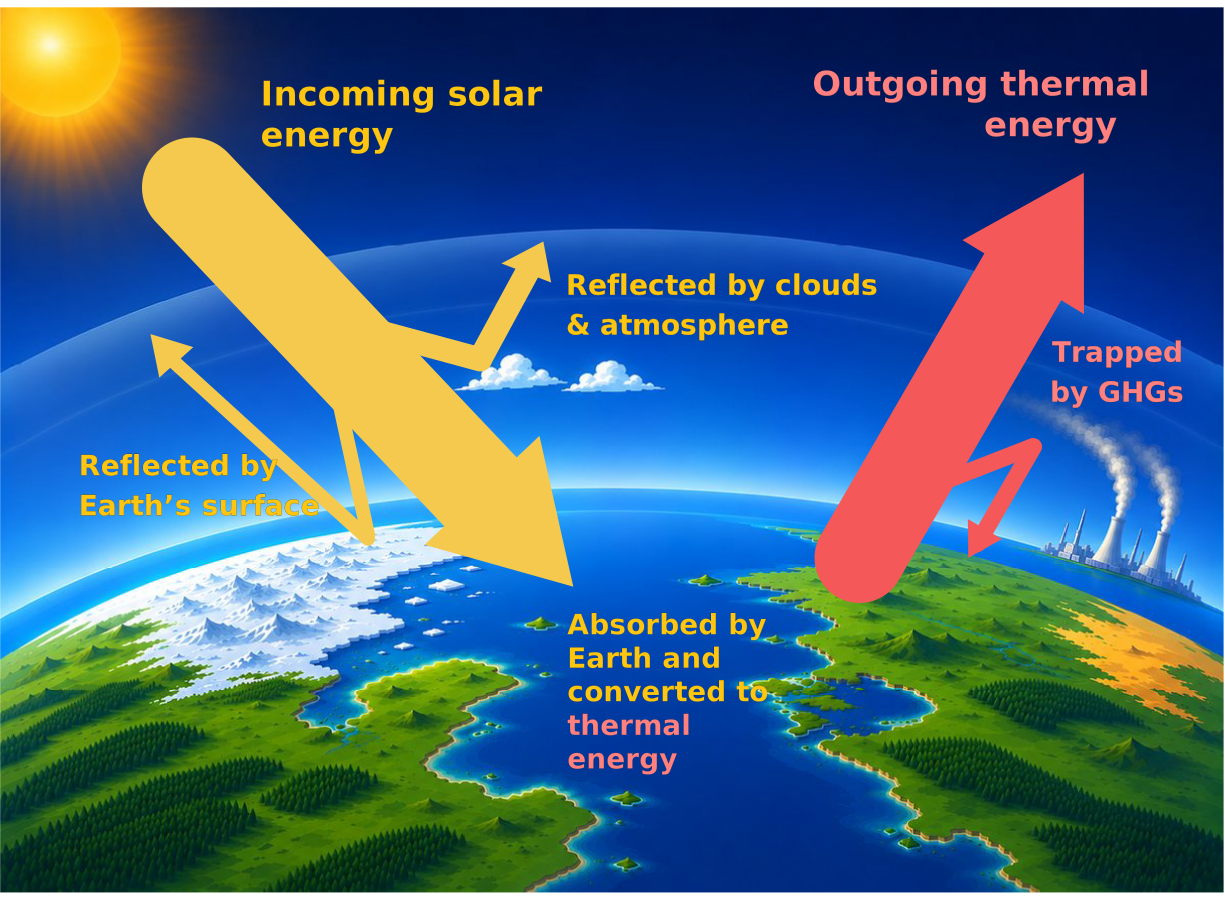
Earth’s energy imbalance–the difference between how much energy Earth absorbs from the sun and how much it radiates back into space–is the fundamental driver of global warming. Roughly 30% of incoming sunlight is reflected back into space, mainly by clouds, ice, and other bright surfaces. The other 70% is absorbed, mainly by dark surfaces like the ocean and forests, before eventually being released back into space as thermal energy: Earth’s Energy Imbalance = Incoming Solar Energy In - Reflected Solar Energy - Outgoing Thermal Energy.
When the climate is stable, as it was for most of the past 12,000 years, Earth’s energy imbalance is zero on average. Since the Industrial Revolution, human greenhouse gas emissions have increased the energy imbalance, thereby causing global warming. Since the early 2000s, observations show that Earth’s energy imbalance has at least doubled, meaning that the planet is accumulating heat much faster than it used to.
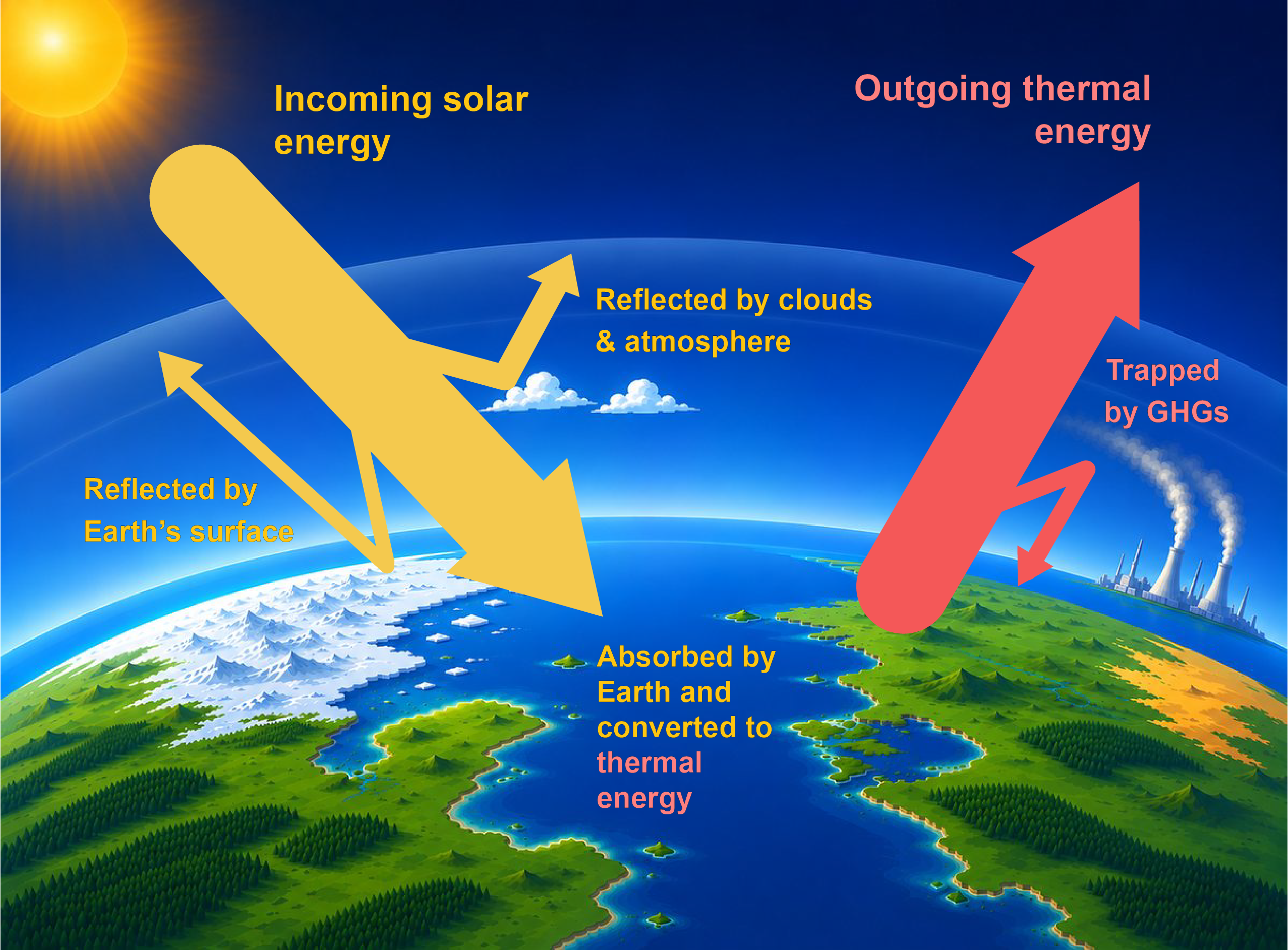
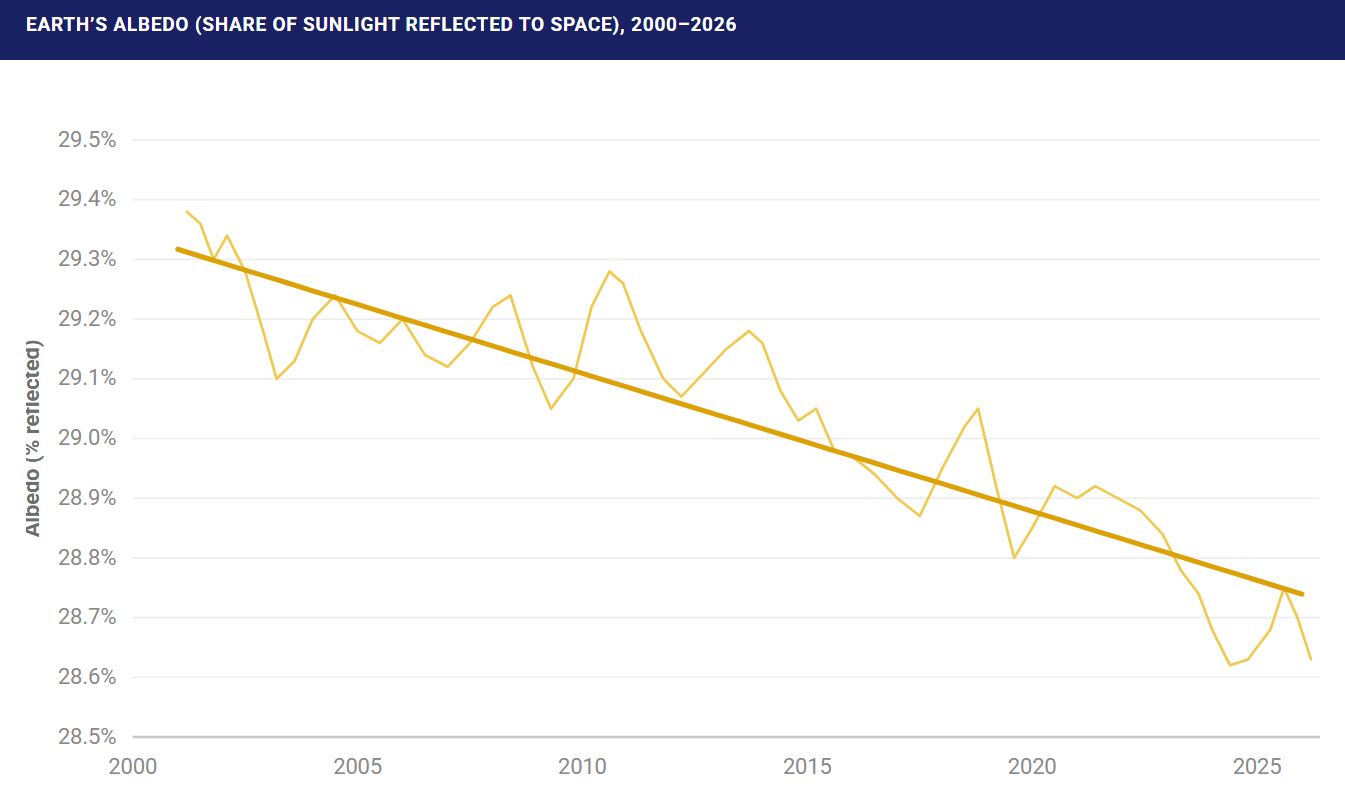
Initially, the increase was driven by greenhouse gas emissions trapping more outgoing thermal energy, the “greenhouse gas effect.”However, the rapid increase in recent years is driven primarily by an additional different consequence of greenhouse gas emissions: Earth’s declining reflectivity. As the planet warms, clouds, snow, and ice cover are contracting and thus reflecting less sunlight back into space. Reductions in particulate pollution (which reflects sunlight) also contribute to the growing energy imbalance.
The warming influence from Earth’s declining reflectivity is massive, roughly equal to that from the greenhouse gas effect of all human carbon dioxide emissions since 1750.
Earth’s energy imbalance is, by definition, what drives global warming. Concerningly, current climate models significantly underpredictunder-predict increases in Earth’s energy imbalance compared to what is actually observed. This suggests that models might also underpredict future warming.
Despite its significance, the research community investigating this topic is small and underfunded, and key questions remain unresolved. This creates important gaps that need to be filled with targeted research efforts. It is particularly important for new peer-reviewed research to be published in time for inclusion in the Intergovernmental Panel on Climate Change (IPCC) 7th Assessment Report, which is a critical pathway for science to inform policy decisions for the next 7-8 years.
At the same time, the satellite-based observation systems we depend on for monitoring and understanding Earth’s energy imbalance are increasingly at risk as existing satellite instruments age and are decommissioned, while future missions face uncertainty. Effort is needed to protect the continuity of these critical observations.
In collaboration with Outlier Projects, and with support from multiple philanthropic partners, Spark is initiating a new effort to support multiple priority opportunities outlined below. An initial round of work is being fast-tracked with the goal of obtaining results in time for inclusion in the upcoming IPCC 7th Assessment Report.
We are supporting international scientific efforts to better understand why Earth has become significantly less reflective and why Earth’s energy imbalance has increased so rapidly in recent decades. A major focus is using new climate models with updated and improved inputs to help understand what is driving observed trends in Earth’s energy imbalance, and where current climate models may still be falling short. Spark is helping support the scientific coordination, workshops, analysis, and publication efforts needed to ensure key findings are completed in time to inform IPCC AR7.
We are supporting research to determine what observed changes in Earth’s energy imbalance could mean for future climate outcomes. This includes efforts to identify which next-generation climate models, known as CMIP7 models, are best able to reproduce observed trends and whether those models project different warming trajectories than the broader set of models currently used in international climate assessments. It also includes reassessingre-assessing the contribution of natural variability to observed trends.
If additional funding becomes available, we may support additional work on priorities 3 and 4 below.
We will support efforts to help protect continuity in the satellite observations needed to monitor Earth’s energy imbalance over time. This includes:
We will support and coordinate the broader scientific and policy field working on Earth’s Energy Imbalance and declining Earth reflectivity. This includes:
Menu
Stay in touch
Sign up to our Spark newsletter and stay updated!