Interactive summaries of important climate science papers and topics.
Earth’s Energy Imbalance and declining reflectivity
Global warming is most often understood through the lens of greenhouse gases trapping heat. But that warming has set off a powerful chain reaction: as the planet heats up, shrinking ice and snow and shifting clouds make Earth less reflective, so it absorbs even more sunlight. Since 2000, this feedback — itself a consequence of human emissions — has become the leading driver of Earth’s growing energy imbalance.

What is Earth’s Energy Imbalance?
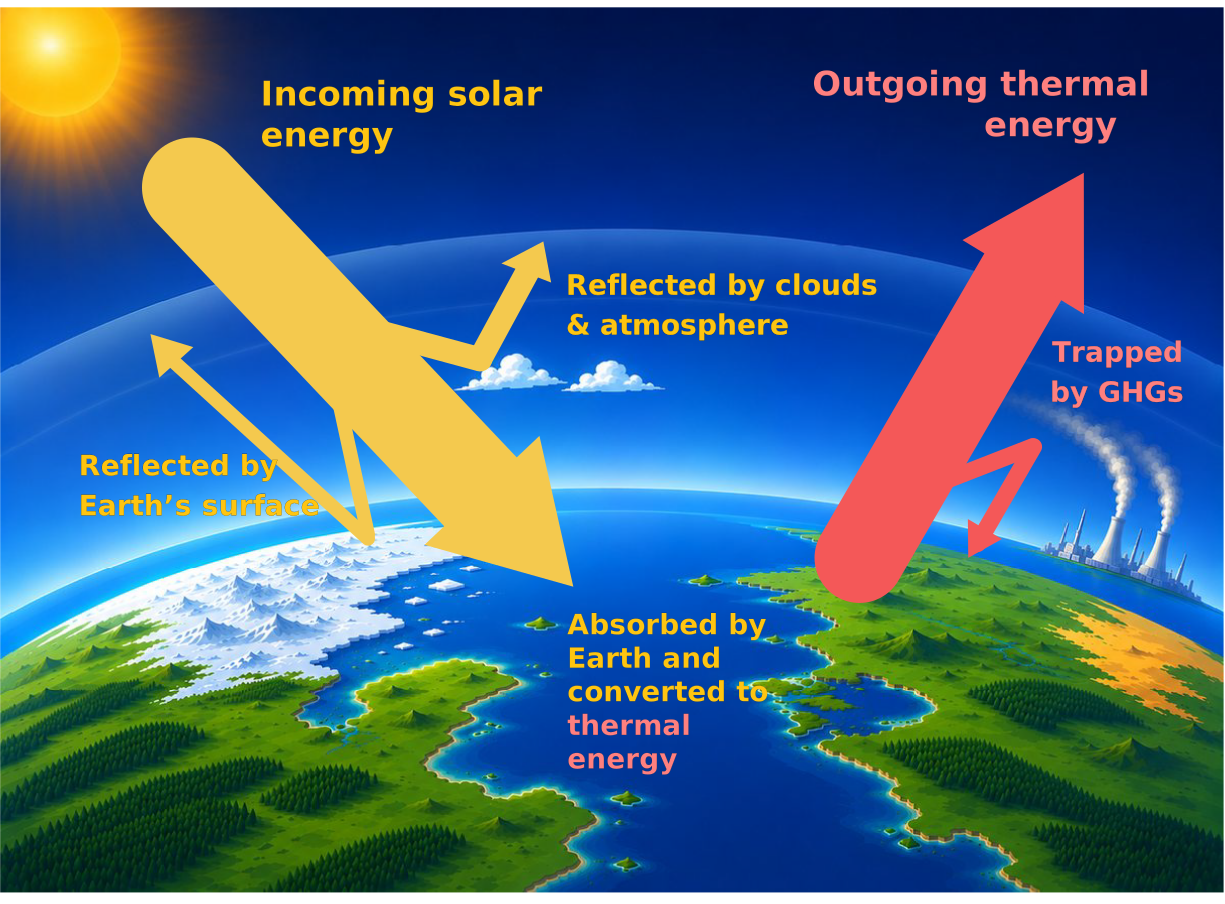
Earth gets its energy from sunlight. Some of that incoming solar energy is reflected back into space; the rest is absorbed by the planet and eventually re-emitted as thermal energy. The difference between how much energy from the sun comes in and how much goes back into space is Earth’s Energy Imbalance. This is the fundamental metric of our planet’s warming.
Energy In and Energy Out
Of the sunlight that reaches Earth, roughly 30% is reflected back to space, mainly by clouds, snow, ice, and other bright surfaces. The remaining 70% is absorbed, mostly by the ocean, forests, and darker land surfaces, before eventually leaving Earth as thermal radiation.
When incoming energy equals outgoing energy, the climate is stable and Earth’s Energy Imbalance is zero. For most of the past 12,000 years, this was the case, at least approximately.
When the imbalance is greater than zero, it means the planet is warming.
Since high-quality satellite observations began around the year 2000, the data show that Earth’s Energy Imbalance has at least doubled, indicating the planet is warming at an accelerating rate.1
More than the simple greenhouse effect alone
Greenhouse gases blocking outgoing radiation (the greenhouse effect) are the root cause of global warming. Perhaps surprisingly, then, satellite observations since 2000 show that declining reflectivity has driven the entire increase in Earth’s Energy Imbalance over this period. Reductions in cloud cover, snow, and ice have made Earth less reflective; cleanup of particulate air pollution, which also reflects sunlight, has further reduced reflectivity. Over this same period, outgoing thermal energy has actually been rising, the opposite of what the simplest greenhouse-effect picture would predict.
Earth is reflecting less sunlight each year
The clearest signature of this shift is Earth’s albedo (the share of incoming sunlight reflected straight back to space). Satellite observations show it has fallen steadily and substantially since 2000, with the decline accelerating in recent years.
12-month running mean. The fraction of incoming sunlight reflected back to space has fallen by roughly 0.6 percentage points since 2000, a small-sounding number with a large warming effect. Source: NASA CERES EBAF-TOA Ed4.2.1. DOI: 10.5067/TERRA-AQUA-NOAA20/CERES/EBAF-TOA_L3B004.2.1
Two causes of declining reflectivity
Earth’s declining reflectivity has two distinct sources. The first is a set of feedbacks triggered by greenhouse-gas warming: cloud cover has contracted (particularly the low, bright clouds over the subtropical oceans that are among Earth’s most powerful reflectors) and ice and snow have retreated, exposing darker ocean and land surfaces beneath. These are the dominant contributors to the decline in reflectivity. The second source is not a consequence of warming but a separate change: cleanup of particulate air pollution (which reflects sunlight) across Europe, North America, and parts of Asia has removed a layer of reflectivity from the atmosphere. Both are contributing to the decline, though their relative magnitudes remain an active area of research.3
There is also a counterintuitive wrinkle: outgoing thermal energy has been increasing, not decreasing, the opposite of what the simple greenhouse-effect picture would predict. This is because warmer surfaces naturally radiate more heat to space, and reduced cloud cover allows more of that energy to escape. This rising outgoing thermal energy partially offsets the warming from declining reflectivity, by roughly half according to observations. But absorbed solar energy is growing faster, so Earth’s Energy Imbalance continues to widen. This behavior was predicted theoretically by Donohoe et al. as early as 2014, before these trends were clearly visible in observations.4
The warming influence from Earth’s declining reflectivity is roughly equal to that from the greenhouse gas effect of all human carbon dioxide emissions since 1750.
Measuring the imbalance from space
We can track Earth’s Energy Imbalance directly from orbit. Since 2000, NASA’s Clouds and the Earth’s Radiant Energy System (CERES), a suite of instruments flown aboard several satellites, has continuously measured how much solar energy Earth reflects and how much thermal energy it radiates back to space. CERES provides the most authoritative, continuous observational record of the planet’s energy budget, and is the foundation for nearly all modern estimates of Earth’s Energy Imbalance.1
These space-based measurements are strongly corroborated by independent ground-based measurements of energy accumulation in the climate system — most notably, the observed warming of the ocean, which absorbs more than 90% of the excess heat. The agreement between these two independent lines of evidence gives scientists high confidence that the satellite-observed increase in Earth’s Energy Imbalance is correct.
The record is striking. Along the best-fit trend line, Earth’s Energy Imbalance rose from about 0.34 watts per square meter around 2000 to roughly 1.43 watts per square meter by early 2026, close to a fourfold increase, or about 0.44 watts per square meter per decade. (Estimates based on shorter records report a doubling; the fuller record points to an even steeper climb.) Because the imbalance is what drives warming, a rising imbalance means the planet is gaining heat faster every year.
12-month running mean of the global net top-of-atmosphere energy imbalance, with a least-squares linear trend (0.44 W/m² per decade; 95% confidence interval 0.40–0.48) and uncertainty band. Any value above zero means the planet is accumulating heat. Source: CERES EBAF Ed4.2.1.1
Why is Earth becoming less reflective?
Earth’s reflectivity (its albedo) has declined measurably since high-quality observations began in 2000. The driving causes fall into three main categories, though their relative contributions and interactions remain an active area of research.
Changing cloud patterns
Clouds are by far Earth’s most powerful reflector. When clouds thin out or shift location, more sunlight reaches and is absorbed by Earth’s surface. Satellite observations from CERES show that reductions in reflected sunlight from clouds account for the majority of the increase in absorbed solar energy since 2000.2
So why are the clouds changing? The leading explanation is a cloud feedback: as greenhouse gases warm the planet, that warming itself reshapes where and how clouds form. Warmer oceans and shifting atmospheric circulation tend to thin out the low, bright clouds that blanket the subtropical oceans. Reduced cloud cover means less reflected sunlight, which fuels further warming. The clouds are not changing on their own; they are responding to the warming already underway.
New analysis identifies reduced cloud cover in these regions, particularly the subtropical oceans, as the single biggest contributor to the 21st century decrease in Earth’s reflectivity.5
Changes in cloud cover also affect outgoing thermal radiation: thinner clouds allow more heat to escape to space. This is part of why outgoing thermal energy is increasing rather than decreasing, the counterintuitive observation described in the previous section.
Tseloudis et al. 2025 Loeb et al. 2021 Donohoe et al. 2014Shrinking ice and snow cover
Ice and snow are among the most reflective surfaces on Earth. As the planet warms, sea ice retreats, glaciers recede, and seasonal snow cover contracts. These bright surfaces are replaced by dark ocean water or bare land, which absorb far more solar energy.
This is a self-reinforcing feedback: warming reduces ice cover, which reduces reflectivity, which causes more warming, which reduces more ice cover. Analysis of CERES observations finds that reductions in surface albedo, primarily from ice and snow loss, represent a significant fraction of the overall increase in absorbed solar radiation.2
This mechanism is well-established and is captured in climate models, though the magnitude of the observed trend exceeds what most models simulate.
Loeb et al. 2021 CERES observationsCleanup of particulate pollution
Particulate air pollutants, tiny solid or liquid particles suspended in the atmosphere, reflect sunlight back to space and also help form brighter, longer-lasting clouds. Regions like Europe, North America, and parts of Asia have dramatically reduced these emissions through pollution controls in recent decades, inadvertently reducing one source of Earth’s reflectivity.
Some studies argue for a substantial role of particulate reductions in driving declining reflectivity. Hodnebrog et al. (2024) finds aerosol cleanup to be a major contributor.6 However, this view is contested: other analyses suggest that particulate decreases in the Northern Hemisphere are largely offset by increases in the Southern Hemisphere, producing little net global effect.
The CERESMIP project, an international coordinated modeling effort, aims in part to resolve these disagreements and quantify the respective contributions of different drivers.7
Hodnebrog et al. 2024 Contested magnitude CERESMIP projectIs this natural variability? The probability that the observed increase in Earth’s Energy Imbalance is due to natural variability alone is less than 1%.89 Solar variability is far too small in magnitude; large volcanic eruptions temporarily reduce absorbed solar energy, the opposite of what is observed; and natural variability simulated in climate models is far too small to account for the 20-plus-year trend. The observed changes are driven largely or entirely by human forcings, primarily greenhouse gas emissions and changes in particulate pollution.
Current climate models underpredict what we observe
Earth’s Energy Imbalance is, by definition, what drives global warming. It is therefore deeply concerning that today’s state-of-the-art climate models systematically underestimate the observed increase in Earth’s Energy Imbalance, typically by 10 to 40%.
Illustrative comparison; individual model results vary. Sources: Myhre et al. 2025;10 CERES EBAF Ed4.2.1.
Why does the model gap matter?
If models cannot accurately reproduce the recent observed increase in Earth’s Energy Imbalance, we have reduced confidence in their projections of future warming. Earth’s Energy Imbalance directly drives temperature rise. A model that underestimates the growing energy imbalance may also underestimate how much warming lies ahead.
This concern is not merely theoretical. The record-breaking global heat of 2023 and 2024 appears to have been partly driven by the rising Energy Imbalance.11
Low-sensitivity models perform especially poorly
A troubling pattern has emerged: the models that predict the least warming in response to a given increase in atmospheric carbon dioxide are systematically the worst at reproducing observed trends in both absorbed solar radiation and outgoing thermal radiation.10
This suggests that such models should be given less weight in projections of future climate. If so, the range of plausible future warming would shift substantially upward.
We can only see this because of satellites — and that view is at risk
Our ability to understand what is driving growth in Earth’s Energy Imbalance depends on continuing the space-based observations.
Earth’s Energy Imbalance is a small signal that only reveals itself over decades. Detecting a trend of less than half a watt per square meter per decade demands instruments calibrated to extraordinary precision, and crucially, records that overlap in time, so each new instrument can be cross-checked against the one before it. If an instrument fails before its successor reaches orbit, a gap opens in the record, and a gap cannot be filled in after the fact. Even a short interruption can introduce enough uncertainty to obscure the very trend scientists are trying to measure.
Today, that continuity rests largely on NASA’s CERES instruments, which have flown since 2000. But these instruments are aging, and some are already being decommissioned. The satellites carrying them were never meant to last forever, and the missions meant to replace them face funding and launch uncertainty.
Nor can ground-based measurements substitute for the space-based record. While ocean heat content and other ground-based indicators independently confirm that Earth’s Energy Imbalance is growing (a reassuring cross-check), they measure only the net accumulation of energy. Satellites measure the incoming and outgoing flows separately, and at every location on Earth. That spatial and mechanistic detail is irreplaceable for understanding what is driving the changes. And ground-based records face their own continuity risks, making reliance on them alone a fragile alternative.
Until recently, the United States had six instruments in orbit measuring Earth’s Energy Imbalance. Today there are four; soon there will be only two, both already very old. The fleet is shrinking just as the imbalance it measures is changing faster than ever.
Why this matters — urgently
Despite its potential significance for projections of future warming, the research community investigating Earth’s Energy Imbalance and declining reflectivity is small and underfunded. Key questions remain unresolved, and the window to inform upcoming policy-relevant science assessments is narrow.
Warming projections may be too low
If current models systematically underpredict the growing Energy Imbalance, implied future warming may be higher than mainstream projections suggest, particularly if low-sensitivity models are given less weight.
The IPCC window is closing
The Intergovernmental Panel on Climate Change’s 7th Assessment Report, a primary pathway for science to inform global policy, is now being written. New peer-reviewed findings must be published soon to be included.
A field that needs building
The research community working on Earth’s Energy Imbalance and declining reflectivity is unusually small relative to the importance of the issue. Sustained investment in scientific coordination, workshops, and training is needed.
Critical observations are at risk
The CERES satellite instruments that provide the observational foundation for this science are aging. Future missions, including NASA’s planned Libera satellite and the next-generation DEMETER instrument, face funding and launch uncertainty.
What Spark is doing
In collaboration with Outlier Projects and with support from multiple philanthropic partners, Spark is supporting a focused effort around four priorities:
More climate science explainers