"In a rapidly evolving scientific field, regular strategic alignment is not optional—progress cannot be left to chance or to infrequent check-ins. Scientific breakthroughs, regulatory shifts, market signals, and on-farm realities are evolving in real time. If we are serious about delivering measurable climate impact on a meaningful timeline, we must regularly come together to assess what’s working, confront barriers, align priorities, and adjust course.” -Charles Brooke, Program Lead, Livestock Enteric Methane Mitigation
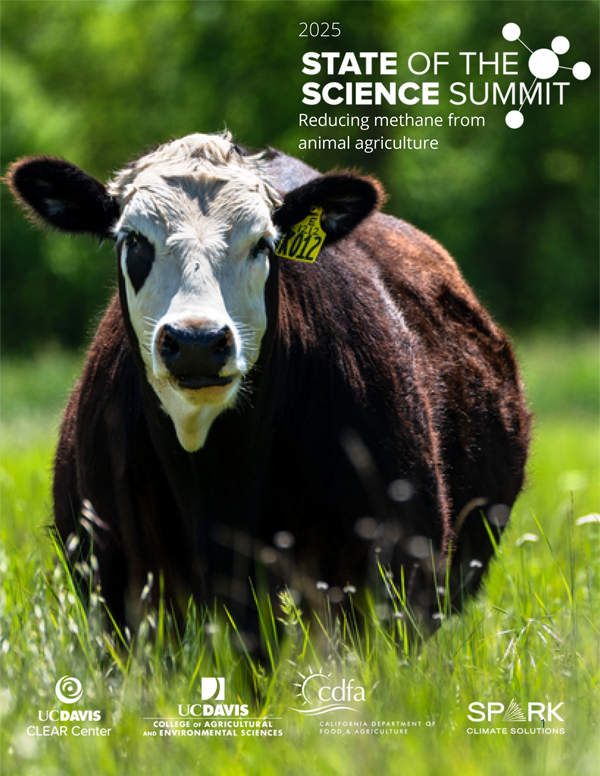
The 2025 State of the Science Report: Reducing Methane from Animal Agriculture is now available, capturing key insights, research advances, and collaboration from the third annual summit held May 19–21, 2025 at the University of California, Davis. The event brought together more than 300 participants from 17 countries—including researchers, producers, policymakers, and NGOs—to explore practical, science-based strategies for reducing methane emissions from livestock.
Co-organized by Spark Climate Solutions, University of California Davis’ CLEAR Center and the College of Agricultural and Environmental Sciences, and the California Department of Food and Agriculture, the summit focused on strengthening scientific understanding and collaboration to advance livestock methane solutions—one of the largest opportunities for near-term climate action.
Because methane is a powerful but short-lived climate pollutant, cutting emissions is one of the fastest ways to slow warming. Ambitious mitigation of enteric methane could avoid roughly 4 gigatons of CO₂-equivalent emissions per year by the end of the century.
Spark works with partners to help grow and coordinate the scientific field needed to develop effective solutions, while engaging industry and policymakers to help build the markets that can scale them. The State of the Science Summit is a key part of that effort—aligning researchers, surfacing priorities, and strengthening collaboration across the global community working on livestock methane.
The 2025 report offers both a snapshot of where the field stands today and outlines pathways for where it can go next.
Register for the 2026 State of the Science Summit
To make this growing body of knowledge more accessible, Spark also launched an interactive tool that helps users explore insights from the conference.
"In a rapidly evolving scientific field, regular strategic alignment is not optional—progress cannot be left to chance or to infrequent check-ins. Scientific breakthroughs, regulatory shifts, market signals, and on-farm realities are evolving in real time. If we are serious about delivering measurable climate impact on a meaningful timeline, we must regularly come together to assess what’s working, confront barriers, align priorities, and adjust course.” -Charles Brooke, Program Lead, Livestock Enteric Methane Mitigation
The 2025 State of the Science Report: Reducing Methane from Animal Agriculture is now available, capturing key insights, research advances, and collaboration from the third annual summit held May 19–21, 2025 at the University of California, Davis. The event brought together more than 300 participants from 17 countries—including researchers, producers, policymakers, and NGOs—to explore practical, science-based strategies for reducing methane emissions from livestock.
Co-organized by Spark Climate Solutions, University of California Davis’ CLEAR Center and the College of Agricultural and Environmental Sciences, and the California Department of Food and Agriculture, the summit focused on strengthening scientific understanding and collaboration to advance livestock methane solutions—one of the largest opportunities for near-term climate action.
Because methane is a powerful but short-lived climate pollutant, cutting emissions is one of the fastest ways to slow warming. Ambitious mitigation of enteric methane could avoid roughly 4 gigatons of CO₂-equivalent emissions per year by the end of the century.
Spark works with partners to help grow and coordinate the scientific field needed to develop effective solutions, while engaging industry and policymakers to help build the markets that can scale them. The State of the Science Summit is a key part of that effort—aligning researchers, surfacing priorities, and strengthening collaboration across the global community working on livestock methane.
The 2025 report offers both a snapshot of where the field stands today and outlines pathways for where it can go next.
Register for the 2026 State of the Science Summit
To make this growing body of knowledge more accessible, Spark also launched an interactive tool that helps users explore insights from the conference.
"In a rapidly evolving scientific field, regular strategic alignment is not optional—progress cannot be left to chance or to infrequent check-ins. Scientific breakthroughs, regulatory shifts, market signals, and on-farm realities are evolving in real time. If we are serious about delivering measurable climate impact on a meaningful timeline, we must regularly come together to assess what’s working, confront barriers, align priorities, and adjust course.” -Charles Brooke, Program Lead, Livestock Enteric Methane Mitigation
The 2025 State of the Science Report: Reducing Methane from Animal Agriculture is now available, capturing key insights, research advances, and collaboration from the third annual summit held May 19–21, 2025 at the University of California, Davis. The event brought together more than 300 participants from 17 countries—including researchers, producers, policymakers, and NGOs—to explore practical, science-based strategies for reducing methane emissions from livestock.
Co-organized by Spark Climate Solutions, University of California Davis’ CLEAR Center and the College of Agricultural and Environmental Sciences, and the California Department of Food and Agriculture, the summit focused on strengthening scientific understanding and collaboration to advance livestock methane solutions—one of the largest opportunities for near-term climate action.
Because methane is a powerful but short-lived climate pollutant, cutting emissions is one of the fastest ways to slow warming. Ambitious mitigation of enteric methane could avoid roughly 4 gigatons of CO₂-equivalent emissions per year by the end of the century.
Spark works with partners to help grow and coordinate the scientific field needed to develop effective solutions, while engaging industry and policymakers to help build the markets that can scale them. The State of the Science Summit is a key part of that effort—aligning researchers, surfacing priorities, and strengthening collaboration across the global community working on livestock methane.
The 2025 report offers both a snapshot of where the field stands today and outlines pathways for where it can go next.
Register for the 2026 State of the Science Summit
To make this growing body of knowledge more accessible, Spark also launched an interactive tool that helps users explore insights from the conference.
Stay in touch
Sign up to our Spark newsletter and stay updated!
Menu
Stay in touch
Sign up to our Spark newsletter and stay updated!