Spark Climate Solutions is looking forward to taking part in the American Geophysical Union annual meeting December 7-11, 2026 in San Francisco. Our experts are leading and participating in a number of sessions throughout the week. Below are several Spark-led sessions. Don't hesitate to reach out to events@sparkclimate.org with any questions or to meet up with the Spark team in San Francisco.

What: Synthetic nitrogen fertilizer use has enabled greatly improved human nutrition, but only about 15% of nitrogen inputs to croplands is consumed by humans, resulting in losses to water and air with unsustainable environmental and human health impacts. This session outlines a vision for a more circular, targeted, and efficient use of nitrogen on croplands, including modeled results on how this proposed transformation could reduce nitrogen losses and improve productivity in U.S. agriculture.
When: Wednesday, 9 December 2026, 08:30 - 08:39
Where: 2010 - West (MC)
Authors: Eric A Davidson, Maya Almaraz, and Maria Bowman, Spark Climate Solutions; Edward Buckler and Sheri Spiegal, USDA Agricultural Research Service; Michael J Castellano, Iowa State University; Xin Zhang, University of Maryland Center for Environmental Science Appalachian Laboratory
What: Atmospheric oxidation enhancement is a proposed category of methane removal that involves dispersing oxidizing agents to accelerate the natural oxidation of atmospheric methane. This poster session presents a quantitative assessment framework for evaluating the feasibility of different approaches based on the ratio of oxidized methane mass to dispersed material mass.
When: Thursday, 10 December 2026, 08:30 - 12:00
Where: South - Poster Hall (Hall ABC) (MC)
Author: Sam Abernethy, Spark Climate Solutions
What: Methane is a climate super pollutant. While strategies for destroying methane at concentrated sources are advancing, technologies for mitigating dilute methane remain nascent. This session spans the full spectrum of methane mitigation, from new ways to cut emissions to atmospheric methane removal. It runs in two parts:
Chairs: Sam Abernethy, Spark Climate Solutions; Yangyang Xu, Texas A&M University; Hinsby Cadillo-Quiroz, Arizona State University; Audrey Parker, Massachusetts Institute of Technology
What: This session presents new research on warming-induced emissions from wetlands, permafrost, freshwaters, and wildfires, finding they could add 0.2–0.4 °C of warming by 2100. This corresponds with a ~20–30% amplification of anthropogenic global warming, underscoring the importance of reducing direct human emissions and incorporating warming-induced emissions in climate accounting and policy frameworks.
When: Thursday, 10 December 2026, 11:30 - 11:40
Where: 3009 - West (MC)
Authors: Sam Abernethy, Danie Potocek, Phil Duffy, Ilissa Ocko, and Ben Poulter, Spark Climate Solutions; Christina Schaedel, Susan Natali, and Brendan M Rogers, Woodwell Climate Research Center; Brian Buma, Environmental Defense Fund; Robert B Jackson, Stanford University
What: The Warming-Induced Emissions Model Intercomparison Project is an effort to bring together modeling groups from around the world to better quantify how climate change is causing some natural systems - such as thawing permafrost and warming wetlands - to emit greater amounts of greenhouse gases. This session presents preliminary results and implications for the remaining carbon budget and future climate pathways.
When: Friday, 11 December 2026, 08:30 - 12:00
Where: South - Poster Hall (Hall ABC) (MC)
Authors: Tom Colligan, Ben Poulter and Danie Potocek, Spark Climate Solutions
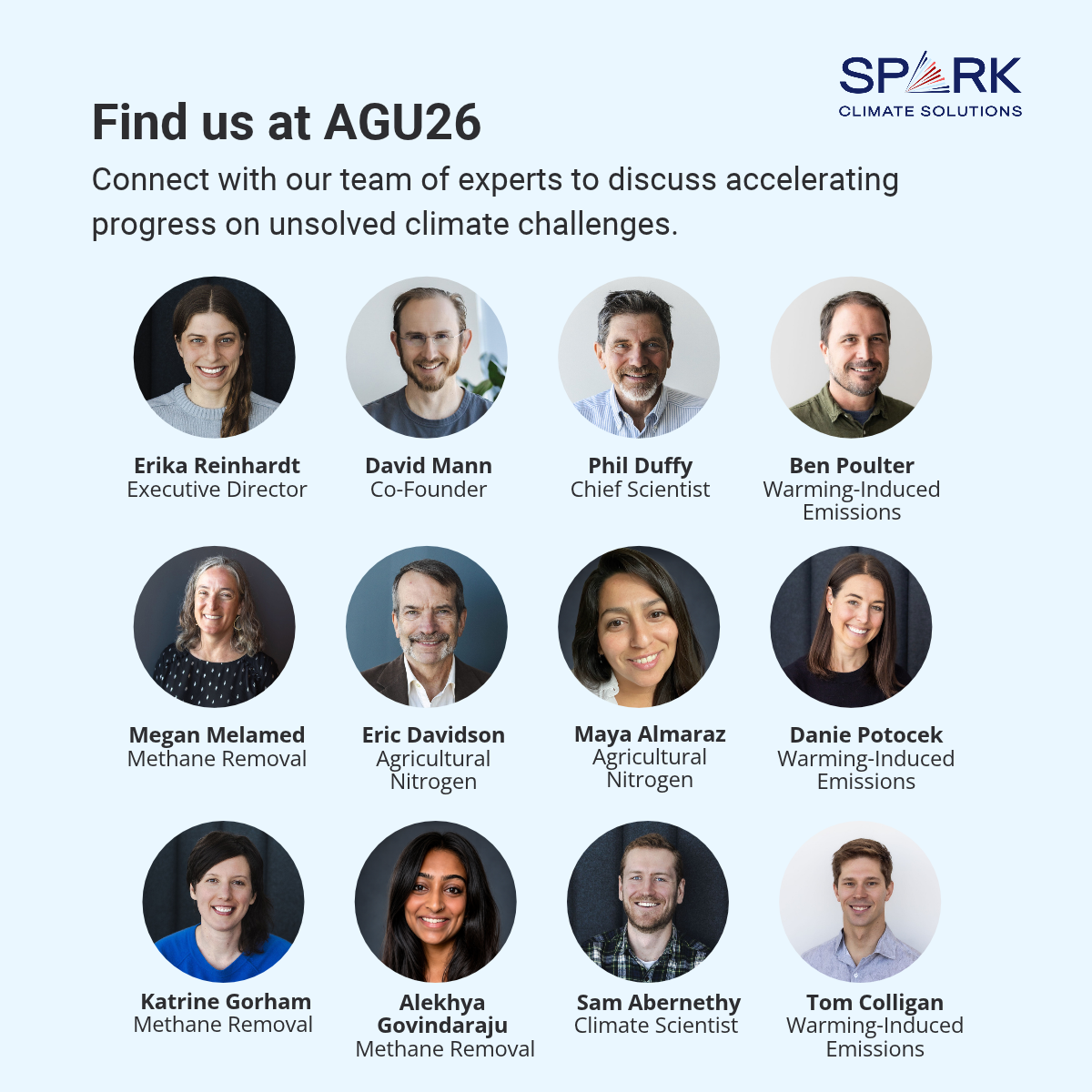
Spark Climate Solutions is looking forward to taking part in the American Geophysical Union annual meeting December 7-11, 2026 in San Francisco. Our experts are leading and participating in a number of sessions throughout the week. Below are several Spark-led sessions. Don't hesitate to reach out to events@sparkclimate.org with any questions or to meet up with the Spark team in San Francisco.
What: Synthetic nitrogen fertilizer use has enabled greatly improved human nutrition, but only about 15% of nitrogen inputs to croplands is consumed by humans, resulting in losses to water and air with unsustainable environmental and human health impacts. This session outlines a vision for a more circular, targeted, and efficient use of nitrogen on croplands, including modeled results on how this proposed transformation could reduce nitrogen losses and improve productivity in U.S. agriculture.
When: Wednesday, 9 December 2026, 08:30 - 08:39
Where: 2010 - West (MC)
Authors: Eric A Davidson, Maya Almaraz, and Maria Bowman, Spark Climate Solutions; Edward Buckler and Sheri Spiegal, USDA Agricultural Research Service; Michael J Castellano, Iowa State University; Xin Zhang, University of Maryland Center for Environmental Science Appalachian Laboratory
What: Atmospheric oxidation enhancement is a proposed category of methane removal that involves dispersing oxidizing agents to accelerate the natural oxidation of atmospheric methane. This poster session presents a quantitative assessment framework for evaluating the feasibility of different approaches based on the ratio of oxidized methane mass to dispersed material mass.
When: Thursday, 10 December 2026, 08:30 - 12:00
Where: South - Poster Hall (Hall ABC) (MC)
Author: Sam Abernethy, Spark Climate Solutions
What: Methane is a climate super pollutant. While strategies for destroying methane at concentrated sources are advancing, technologies for mitigating dilute methane remain nascent. This session spans the full spectrum of methane mitigation, from new ways to cut emissions to atmospheric methane removal. It runs in two parts:
Chairs: Sam Abernethy, Spark Climate Solutions; Yangyang Xu, Texas A&M University; Hinsby Cadillo-Quiroz, Arizona State University; Audrey Parker, Massachusetts Institute of Technology
What: This session presents new research on warming-induced emissions from wetlands, permafrost, freshwaters, and wildfires, finding they could add 0.2–0.4 °C of warming by 2100. This corresponds with a ~20–30% amplification of anthropogenic global warming, underscoring the importance of reducing direct human emissions and incorporating warming-induced emissions in climate accounting and policy frameworks.
When: Thursday, 10 December 2026, 11:30 - 11:40
Where: 3009 - West (MC)
Authors: Sam Abernethy, Danie Potocek, Phil Duffy, Ilissa Ocko, and Ben Poulter, Spark Climate Solutions; Christina Schaedel, Susan Natali, and Brendan M Rogers, Woodwell Climate Research Center; Brian Buma, Environmental Defense Fund; Robert B Jackson, Stanford University
What: The Warming-Induced Emissions Model Intercomparison Project is an effort to bring together modeling groups from around the world to better quantify how climate change is causing some natural systems - such as thawing permafrost and warming wetlands - to emit greater amounts of greenhouse gases. This session presents preliminary results and implications for the remaining carbon budget and future climate pathways.
When: Friday, 11 December 2026, 08:30 - 12:00
Where: South - Poster Hall (Hall ABC) (MC)
Authors: Tom Colligan, Ben Poulter and Danie Potocek, Spark Climate Solutions
Stay in touch
Sign up to our Spark newsletter and stay updated!
Menu
Stay in touch
Sign up to our Spark newsletter and stay updated!